


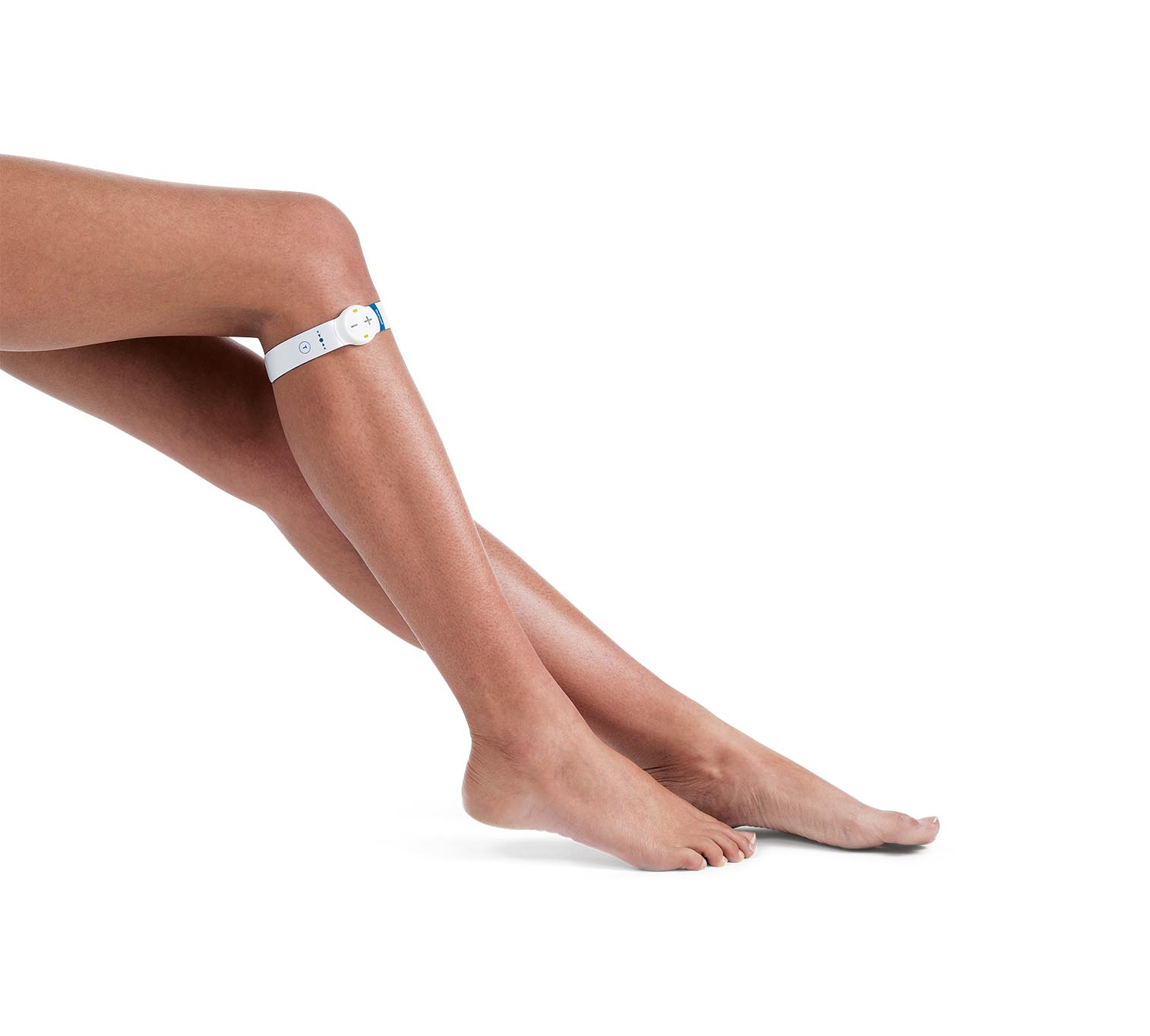
The geko® device, powered by OnPulse™ neuromuscular electrostimulation technology, is clinically proven to increase blood flow for the promotion of wound healing and the reduction of oedema. The size of a wristwatch and worn at the knee, battery powered, disposable geko® device gently stimulates the common peroneal nerve activating the calf and foot muscle pumps, resulting in increased venous, arterial and microcirculatory blood flow. The geko® W3 device is FDA & TGA approved and CE marked as a medical device. Its intended uses include: – Increasing blood circulation – Prevention and treatment of oedema – Promotion of wound healing
Code
Product Description
Dimensions
LMFK-W3RW01-07
Patient Treatment Pack (14 days)
186mm x 31mm x 9.35mm (Weight = 10g device only)
Videos


Factsheets/Resources
Firstkind Ltd geko® Wound W3 Instructions for Use
DownloadFirstkind Ltd geko® Wound Care brochure
DownloadFirstkind Ltd geko® Wound Therapy Randomised self-controlled trial
DownloadFirstkind Ltd geko® W3 Wound Care Clinical Evidence Summary
DownloadFirstkind Ltd geko® Device Annotated Bibliography
DownloadFrequently Asked Questions
What is the geko® W3 device?
The geko® device, powered by OnPulse™ neuromuscular electro-stimulation technology, is clinically proven to increase blood circulation for the treatment of oedema and the promotion of wound healing. It is used in a clinic or home setting, and in hospitals.
What does the geko® device do?
The geko® device increases arterial, venous and microcirculatory blood flow. It is FDA marked and CE marked (CE1639) and the intended use is for:
- increased blood circulation
- promoting wound healing
- the treatment of venous insufficiency and ischemia
- the prevention and treatment of oedema
How does the geko® device work?
Worn at the knee, the geko® device delivers painless electrical impulses to the common peroneal nerve to activate the calf and foot muscle pumps of the lower leg to increase venous, arterial and microcirculatory blood flow. The increase in blood flow transports oxygen to the wound bed promoting conditions favourable to wound healing.
Powered by a wrist-watch size battery with software controlled by plus and minus buttons, the self-adhesive geko® device shapes itself easily and comfortably to the leg.
Green flashing LED lights indicate when the device is switched on and which stimulation level has been set. On the underside of the strap, covered by a water-based conductive hydrogel for secure adhesion, positive and negative electrodes deliver painless neuromuscular electro-stimulation to the common peroneal nerve.
Who is using the geko® device?
The geko® device, typically used in a clinic or home care setting, is also used in hospital by:
- Tissue viability nurses
- Vascular surgeons
- Wound care specialists
Which locations on the body can I wear the geko® device?
The geko® device is only to be used on the lower limbs. Secure the device to the leg so that the location marker (the line of arrows) is positioned directly over the centre of the fibula head. Correctly fitted, the longer tail should wrap around to the rear of the leg, below and parallel to the crease of the knee. This will place the negative electrode over the common peroneal nerve and will position the ‘plus’ button at the front of the leg and the ‘minus’ button to the rear. The device can also be placed in two alternative fitting locations, just above and just below the crease of the knee aligned to the lateral outer tendon.
How long should I wear the geko® device for leg ulcer healing?
- Each geko® device will provide you with 2 days treatment and should be worn for 12-hours per day. Treatment can be paused and the device may be removed for short periods of time (up to 3 hours in total) when washing, driving or having various tests.
- The geko® device should be removed between treatments and stored on the backing card provided. It is important that you do not leave the device on your skin during your 12-hour break as this gives your skin time to breathe in between treatments.
- A minimum of 6-hour break between each 12-hour treatment is required, should you try to start the device too soon, the device will give a single long flash (0.5s) and will not stimulate.
- The device will switch off automatically after 12 hours. If you have paused the device, it will continue until it has completed the full 12 hour dose. You do not have to worry about counting the hours, it does it for you.
What is considered the correct level of stimulation?
When activated look for a discernible movement of the muscles in the lower leg and visible outwards and upwards movement of the foot. It is not sufficient to see only a slight movement in the muscles of the lower leg alone. The movement in both the lower leg and foot should be discernible.
Is the geko® device painful to use?
No, there is no sensation of pain. There is the feeling of the muscles in the lower leg contracting every second which can take a few moments to adjust to. Thereafter it is common to forget you are wearing the device.
How does the geko® device increase peripheral arterial blood flow?
The geko® device increases venous return in the lower limbs. This reduction in venous pressure reduces peripheral capillary resistance, which enhances arterial blood flow – illustrated by direct measurement of arterial system, increased cardiac ejection and a reduction/abolition of the diastolic flow reversal, the consequences of which allow delivery of more oxygenated blood and nutrients to flow to the entire lower limb. Increasing blood circulation increases Transcutaneous Oxygen Tension (TCpO2) which is a predictor of tissue viability and ischemic wound healing.
- Increases lower limb and foot skin tissue oxygen which assists the removal of toxins in the wound bed
- Also assists in the removal of carbon dioxide and metabolic waste from the lower limb
Can I sleep with the geko® device on?
There is no detrimental effect to sleeping with the geko® devices on. However, if you are finding the devices to be disruptive then discuss this with your healthcare professional who may advise you to either lower the settings.
Is the geko® device waterproof?
The geko® device must be kept clean & dry. Do not bathe or shower whilst wearing the device. Prolonged exposure to water will soften the hydrogel and adhesion may be lost. Immersion may also affect the electronics and prevent proper operation. In the event that the device becomes wet, either by water or bodily fluid, there is no danger to the patient.
How many times can I use a single geko® device?
For wound therapy, the geko® device must be reused for a maximum of 2 days, then discarded. It can be used over a 24 hour period. The device can be stored using the backing card.
The usage duration for the geko® W3 device depends on the indication and specific instructions. Here are the key points:
- For wound therapy with the W3 model: each device is intended for 2 days of treatment (wearing ~12 hours per day).
- Within that treatment, you need to give your skin a break: there must be at least a ~6-hour rest period between sessions
After those 2 days, the device must be discarded (single-use per patient course). So in short: for the W3 wound therapy use, you can wear it 12 hours/day for up to 2 days, then discard
Does the geko® hydrogel contain latex or phthalates?
No. The geko® device is not manufactured using either latex or phthalates.
I am allergic to sticking plasters. Is the geko® device likely to cause skin irritation?
Sticking plasters use a different adhesive to that used by the geko® device. Skin reactions, such as rashes, are a recognised minor complication associated with electro-stimulation. Some skin reactions with the geko® device have been reported to us, but we do not yet have enough data to say whether the incidences reported are in line with other electro-stimulation devices. We do warn users of the potential for skin reactions in our Instructions for Use. In some cases skin inflammation or irritation can develop in the contact area, either remove the device or re-attach in the alternative fitting location. Details on the alternative fitting locations are explained in the Instructions for Use.
We are not aware of any instances where the skin reactions represent a serious risk to the health of the patient.
There may be some instances where a minor irritation is acceptable when weighed against the therapeutic benefits of the geko® device. This must be discussed and agreed with your healthcare professional.
Does the geko® device contain anything that will damage the environment?
No. The geko® device does not contain anything that is known to damage the environment. The geko® device complies with current EU environmental legislation.
Do we have any safety evidence for the geko® device?
We have considered the possible risks associated with using the geko® device. To ensure its safety we have designed and manufactured the geko® device in accordance with the International standard for managing the risks of medical devices, ISO 14971. Using this standard as a basis we have designed and manufactured the geko® devices to be intrinsically safe.
We have conducted extensive biological safety testing, to the International biocompatibility standard, ISO 10993, and we have data that shows that the hydrogel has tested negative for cytotoxicity, sensitisation and irritation, and can therefore be considered to be hypoallergenic. We have also conducted extensive electrical safety testing. The key International standards are ISO 60601-1, ISO 60601-1-2 and IEC 60601-2-10, the latter being the International standard for electrical safety for powered muscle stimulators.
All of the above data has been reviewed by our Notified Body (SGS United Kingdom Ltd) prior to giving us the CE Marking certification. SGS United Kingdom Ltd employs experts in biological and electrical safety testing to scrutinise the data that we have to demonstrate that the geko® devices are intrinsically safe and comply with appropriate International safety standards.
We have considered the possible risks associated with using the geko® device. To ensure its safety we have designed and manufactured the geko® device in accordance with the International standard for managing the risks of medical devices, ISO 14971. Using this standard as a basis we have designed and manufactured the geko® devices to be intrinsically safe
Can the geko® device be used during cardiac arrest?
The geko® device has not specifically been tested when external defibrillators are being used. There is a theoretical risk that the geko® device could stop working because of electrical interference, but the device would not incur any damage and there is no additional risk to the patient. The geko® device will continue to work during the use of electro-surgery equipment (diathermy), and so this risk may be small.
How does it differ from other electrical stimulation devices?
The geko® device is unique in that it delivers neuromuscular electro-stimulation via the common peroneal nerve to activate the calf and foot muscle pumps of the lower leg, as opposed to other electro-stimulation devices that stimulate the muscles directly and can be less well tolerated.
What type of electrical stimulation pulse is used by the geko® device?
The geko® device has a constant current, square wave, asymmetrical, charge balanced pulse. The Constant current refers to the output of the geko®device which is constant during the duration of the pulse. The voltage of the device will vary according to the patient’s electrical resistance in order to achieve the current output. The stimulation pulse is defined as a square wave. This means that the stimulation current rises rapidly to the required value, which is maintained for the duration of the pulse, followed by a rapid fall to zero. This creates a rectangular or square shape when measured on an oscilloscope, hence the name.
The stimulation pulse is followed by another (return) pulse of lower intensity, but longer duration (asymmetrical) and opposite polarity, to ensure that the overall electrical charge is zero (charge balanced). This prevents electro-chemical changes in the skin.
Can the geko® device be used in close proximity to open radar transmitters or other sources of short wave radiation?
Do not use in proximity (i.e. within 1 metre) of short wave / microwave equipment as this may affect the geko® device. We are required by international standards to provide this warning, but practically this will not affect hospital patients. This warning does not apply to microwave ovens, which are shielded against transmitting microwave radiation.
What published evidence do you have to support the geko® device claims?
We have a range of published research available for download
[add link to bibliography]
Can the geko® device be used near mobile communications equipment (e.g. cell phones, CB radio)?
Some medical electrical equipment can be affected by mobile communications equipment and other radio sources and we are required by international standards to warn users that medical electrical equipment can be affected by portable and mobile RF communications equipment. The geko® devices however, have been extensively tested and have been shown not to interfere with, or to be interfered by, radio sources such as cell phones and CB radios.
Are there any contraindications for using the geko®device?
There are no contraindications. There are warnings and precautions. Please refer to the Instructions for Use leaflet inside your geko® device foil pouch or available to download here.
Does the geko® device have NICE Guidance supporting its use for the prevention of Venous Thromboembolism (VTE)?
NICE Guidance (MTG19) supports use of the geko® device for people who have a high risk of VTE and for whom pharmacological or other mechanical methods of VTE prevention are impractical or contraindicated.
The savings, as outlined within the NICE guidance, would result from a reduction in the relative risk of DVT and the associated conditions of VTE such as post thrombotic syndrome as well as reduced length of stay.
In high risk patients when a combination of pharmacological and mechanical VTE prophylaxis is desirable but current mechanical prophylaxis is contraindicated or impractical, the geko® device in combination with pharmacological prophylaxis will be cost neutral for up to 3 days compared to pharmacological prophylaxis alone.
The adoption of the NICE guidance and the use of the geko® device supports the NHS objective of providing VTE prevention to all at-risk hospital patients.
How long does the battery last?
The geko® device is intended for 2x 12 hours of use – it has a battery life nominally up to 24 hours. However the software switches the device off, between doses. Please see IFU for further details.
How do I dispose of the geko® device once I have used it?
The geko® device is compliant with the requirements of Directive 2011/65/EU of the European Parliament and of the Council of 8 June 2011 on the restriction of the use of certain hazardous substances in electrical and electronic equipment.
- No specialist measures are required for the disposal of the electronics and battery in the geko® device
- Batteries must be disposed of in accordance with any local legislation
- The battery can be removed by breaking open the housing and prising out the battery
- Do not incinerate the battery
- Dispose of the geko® device as domestic waste
What is the shelf life of the geko® device?
The geko® device has a shelf life of two years and the expiration date is printed on each pack.
Is the geko® device difficult to keep on with confused patients?
Under ‘precautions’ in the instructions for use we do advise to check the device is functioning correctly every 2 hours, so that there is no significant loss of prophylaxis or treatment should the device be interfered with by the patient
Find out more
Bridging true innovation and care.
Learn more about partnering with us to improve patient outcomes.